Instructions
To make this component work follow these steps:
  1. Remove the delete-this-class class from the navbar14_component div. This will change the positioning of the navbar to fixed.
  2. Add the navbar-on-page class to the page-wrapper class. This will ensure that the navbar is centered on the page.
  3. Add the max-width-full class to the main-wrapper class. This will ensure all sections inside of the main wrapper are full-wdith.
Products
Hyperspectral imagery
Archive
Open Data
Technology
Industries
AgriculturePeace and securityForestry and ESGEnergyMining
Company
About usJoin us
Resources
Resource libraryKnowledge centre
Knowledge Centre
Product Guide
Open Data
Product guideOpen data
Partners
Contact Us
Order imagery
Insights

Hyperspectral imaging for military surveillance: airborne vs satellite

Jun 25, 2026
How you should evaluate remote sensing platforms for military intelligence, surveillance, and reconnaissance.
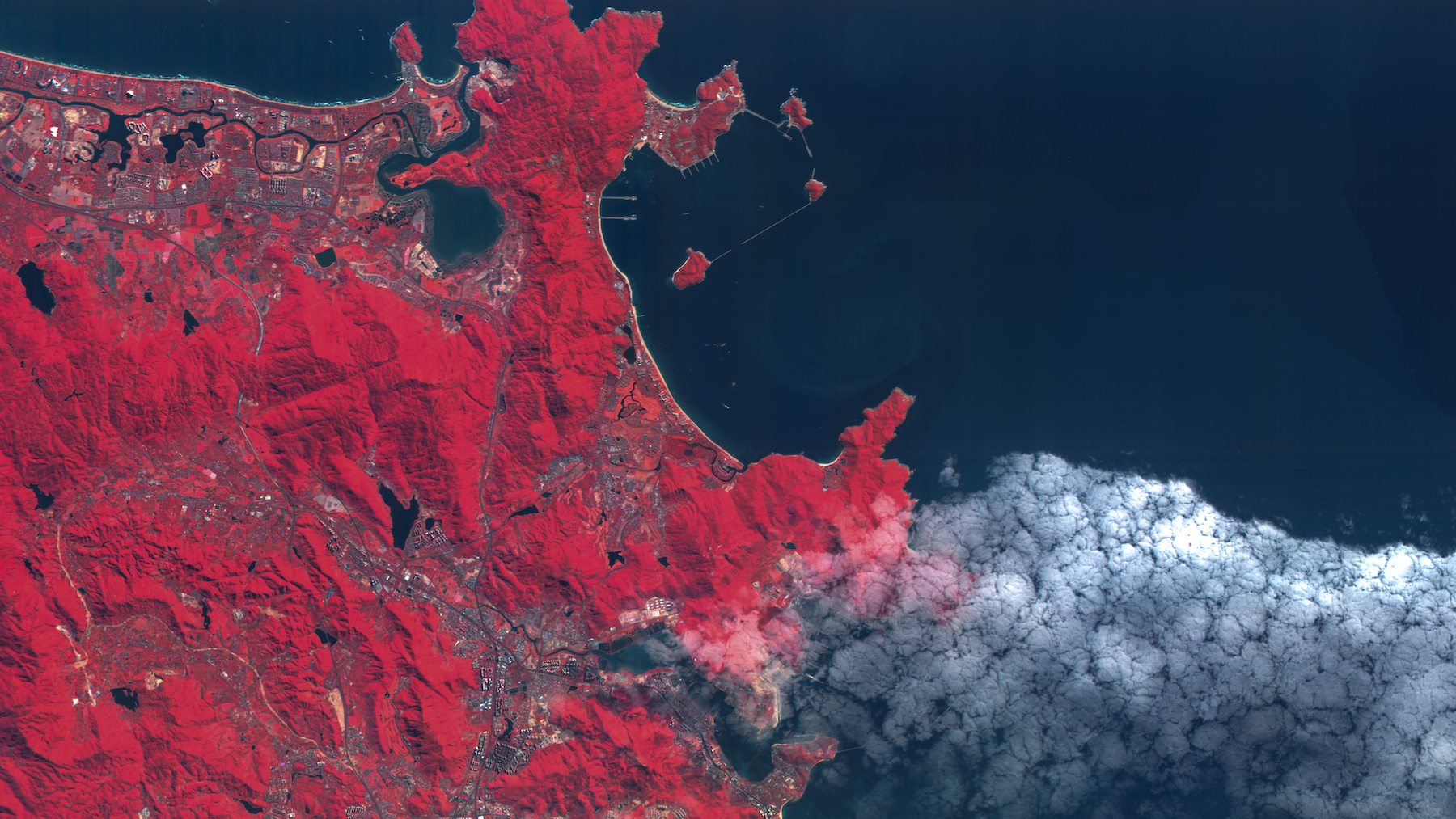
A Dragonette-004 image over the Sohae Satellite Launching Station in North Korea (taken 2026-02-15 02:05:18 UTC).

The biggest gap in maritime surveillance

While there is still a role for conventional technology, legacy sensors leave a critical blind spot in maritime defence:

  1. Material distinction: conventional sensors cannot identify what a target is made of.
  2. Camouflage detection: conventional sensors cannot distinguish camouflaged assets from natural background.
  3. Spectral signatures: conventional sensors cannot detect chemical and material signatures that indicate intent or composition.

To close the gap, defence organizations must rely on hyperspectral imaging. Hyperspectral imaging compliments how radar reveals shape and motion, and how EO/IR cameras capture visual and thermal imagery, by providing more data to make decisions from.

‍

Why use hyperspectral imaging in defence

Hyperspectral systems capture reflected light across dozens or hundreds of narrow spectral bands in a continuous fashion across the spectral range of the sensor, producing a unique fingerprint for every material in the scene. The result is a sensing modality that can:

  • detect concealed or camouflaged targets,
  • identify vessel hull coatings,
  • classify vegetation stress caused by underground activity, and, 
  • discriminate between real equipment and decoys.

Laboratory research has demonstrated classification accuracy above 98% for camouflaged objects in controlled environments1.

‍

What does this mean to your business when selecting your next sensor?

If you are a procurement official or programme manager evaluating hyperspectral as your next ISR investment, the question really is which delivery platform provides the most effective, scalable, and cost-efficient access: a manned or unmanned airborne (or UAS) system, or a satellite constellation.

Side-by-side: satellite vs airborne (or UAS) hyperspectral

The table below compares the two primary delivery platforms. Each has clear strengths. The right choice depends on operational requirements, programme budget, theatre of operations, and mission scope.

Factor Hyperspectral satellite constellation Hyperspectral airborne platform or UAS
Coverage area Global. Wyvern’s Dragonette constellation can image between +/-82° latitude and does not require overflight permission or forward-deployed infrastructure. Regional. Limited to the aircraft’s range and endurance, typically hundreds of kilometres per sortie from available basing.
Spatial resolution Wyvern’s Dragonette constellation has a 5 m ground sampling distance. Sufficient for material classification, wide-area monitoring, and change detection. Sub-metre possible. Higher spatial detail for site-specific analysis and individual small-target identification.
Revisit rate Constellation-driven: Wyvern’s Dragonette constellation has an average revisit of 1 day at 60°, with a maximum gap time of 5 days. Consistent temporal cadence supports change detection and pattern-of-life analysis. On-demand but sortie-dependent. Persistent revisit requires continuous flight operations and maintenance cycles. UAS extends endurance per sortie but still covers one area at a time.
Operational risk No aircrew at risk. No requirement for diplomatic overflight clearance. Requires permissive airspace and is vulnerable to air defences in contested environments. UAS removes aircrew risk but still requires forward basing, maintenance teams, and line-of-sight or SATCOM datalinks.
Cost per km² Low marginal cost once the constellation is operational. Per-scene imagery costs decrease as coverage and archive grow. High per-sortie costs including fuel, maintenance, crew, and logistics. Cost scales linearly with each additional area covered.
Scalability Scales globally with constellation growth. Each additional satellite increases both revisit frequency and total throughput. Scales by adding aircraft, crew, and base infrastructure. Each new theatre of operations requires a separate deployment.
Data continuity Continuous archive growth enables longitudinal analysis, AI model training, and baseline creation over years of collection. Campaign-based data collection. Historical archive depth depends on mission funding continuity and deployment tempo.
Sovereignty + Arctic Persistent coverage of remote areas including the Canadian Arctic without forward-deployed infrastructure or seasonal constraints. Arctic operations limited by extreme range, weather, available basing, and seasonal darkness. Sustained presence is expensive.
Spectral bands Current: 31 VNIR bands at 5 m GSD. Roadmap: VNIR + SWIR for chemical and mineral discrimination, targeting 2028. Can carry broader-band sensors—VNIR, SWIR, MWIR, LWIR—with fewer size, weight, and power constraints.

‍

The pattern is clear. Airborne hyperspectral provides unmatched spatial detail for localized, time-sensitive missions. Satellite hyperspectral provides scalable, and global coverage that modern defence doctrine demands. For most strategic surveillance programmes, the satellite constellation is the more cost-effective foundation, with airborne assets reserved for tactical augmentation when sub-metre resolution is required.

Decision framework: choosing the right platform

For defence planners evaluating hyperspectral investment, the decision between airborne and satellite is not binary. Both platforms have a role, and the strongest ISR architectures combine them. The framework below helps determine which should serve as the primary capability and which as a tactical complement.

Choose satellite first when Choose airborne or UAS first when
Coverage spans national or multi-theatre scale Mission focuses on a single site or small area of interest
Wide area, repeatable monitoring is required over months or years High spatial resolution is essential for the target set
Operating in contested or denied airspace where aircraft face risk Airspace is permissive and forward bases are available
Budget favours low marginal cost at scale over high per-sortie expenditure Budget supports high per-sortie costs for short, focused campaigns
Historical archive depth and AI-driven analytics are programme priorities Immediate, one-off collection is the primary operational need
Sovereign territory includes remote, Arctic, or difficult-to-access regions Broader spectral range—MWIR and LWIR—is required for the mission

‍

For most national-level defence programmes, a satellite constellation provides the foundation: frequent, global, scalable, and cost-effective at wide-area coverage. Airborne assets then serve as tactical complements, deployed for high-resolution, time-sensitive collection over specific areas that satellite cueing has identified as priorities.

The operating principle is straightforward. Satellite hyperspectral data identifies where to look. Airborne assets zoom in on what matters. Together, they deliver an ISR capability that is greater than either platform can achieve alone.

‍

See how hyperspectral fits your mission

Wyvern operates 5 hyperspectral satellites today, delivering 31-band VNIR imagery at 5 m ground sampling distance to defence and commercial customers worldwide. Our new ship identification product is purpose-built for maritime domain awareness, and our analysis-ready data integrates directly into existing C4ISR workflows through standard APIs.

Book a technical consultation to explore how satellite hyperspectral data strengthens your surveillance architecture: wyvern.space/contact

‍

‍1Zhang, Y. et al. Research on Camouflage Recognition in Simulated Operational Environment Based on Hyperspectral Imaging Technology. Journal of Spectroscopy, 2021. https://www.hindawi.com/journals/jspec/2021/6629661/


‍

‍

Share this post
Peace and security
Tag one
Tag two
Tag three
Tag four

Related resources

View All

Blog title heading will go here

news
Nov 6, 2025
Category
5 min read

Blog title heading will go here

Lorem ipsum dolor sit amet, consectetur adipiscing elit. Suspendisse varius enim in eros.
Read more
Category
5 min read

Blog title heading will go here

Lorem ipsum dolor sit amet, consectetur adipiscing elit. Suspendisse varius enim in eros.
Read more

Wyvern selected for NASA satellite data program

News
Jun 23, 2026

Wyvern selected for NASA satellite data program

News
Jun 23, 2026

Sighting the Dark Fleet: Hyperspectral’s Role in Securing Safer Seas

News
Jun 2, 2026

Sighting the Dark Fleet: Hyperspectral’s Role in Securing Safer Seas

News
Jun 2, 2026

Seeing What Others Can’t: How Hyperspectral Data Is Changing Maritime Domain Awareness

Insights
Apr 14, 2026

Seeing What Others Can’t: How Hyperspectral Data Is Changing Maritime Domain Awareness

Insights
Apr 14, 2026
View All

Start using
hyperspectral imagery

And bring a new level of clarity to your operations.
Order imagery
Contact us
Products
Hyperspectral imageryArchiveOpen Data
Industries
AgriculturePeace and securityForestry and ESGEnergyMining
Company
Our technologyOur partnersAbout usJoin usContact us
Subscribe
Join our newsletter to stay up to date on all things Wyvern.
By subscribing you agree to with our Privacy Policy and provide consent to receive updates from our company.
Thank you! You are now subscribed!
Oops! Something went wrong while submitting the form.
© 2026 Wyvern Inc. All rights reserved.
Privacy Policy
We use cookies to enhance your experience.
Learn more
Accept