
Breaking barriers and reaching for the stars: Celebrating women and girls in science at Wyvern

This day, celebrating its tenth anniversary, serves as a reminder of both the importance of gender equality in STEM fields and the need to break down barriers that have historically limited opportunities for women and girls in science.
The Importance of Women in STEM
Undoubtedly, innovations from STEM fields have improved nearly every aspect of human life. In modern science, innovations emerge through the dedicated efforts and creativity of multiple scientists; they are not created in isolation by an individual. Most people agree, at least in my experience, that science is a team sport. Within these teams, diversity of all kinds is key.
Gender-diverse teams produce more novel and higher-quality scientific studies. People of different genders and various cultural, ethnic, and socioeconomic backgrounds contribute unique perspectives and problem-solving approaches, leading to a richer pool of ideas and more innovative solutions.
In particular, when trying to solve complex problems, the diversity of the problem solvers actually matters more than the individual capability of the problem solvers. Seeing the problem in a different way is often the key to a solution breakthrough.
Bringing together diverse perspectives also helps to address biases and blind spots that can otherwise arise through homogeneous perspectives, leading to solutions that cater to a broader range of societal needs. For example, development and applications of artificial intelligence would benefit from diverse perspectives in order to avoid reproducing bias.
Additionally, studies have shown that diversity is just good business, leading to higher revenues and market value.
On this International Day of Women and Girls in Science, we emphasize the importance of gender diversity while recognizing that there are many other facets of diversity that also matter. Today, 34% of Canadians with a STEM degree are women, but women make up less than a quarter of the STEM workforce in Canada. Without including women and underrepresented genders in STEM, valuable perspectives that shape these fields and their approaches to innovation and problem-solving are being overlooked.
Women and Girls in Science: A Key to Canada’s Space Sector
Canada has long been at the forefront of space exploration and technology, from Alouette-1 (the first satellite built by a country other than the US or the then Soviet Union), to Canadarm, to our contributions in Mars exploration, astronomy, asteroid missions, and others.
According to the Canadian Space Agency’s 2023 State of the Canadian Space Sector Report which surveyed 140 space-sector organizations, the workforce in Canada’s space sector comprises 69% men, 31% women, and 0.2% non-binary individuals. These self-reported statistics may include administrative and business support roles, which although very crucial to achieving success in the sector, don’t put women in roles where they can contribute to technical solutions and scientific innovation effectively. Despite this, women play an essential role in driving Canada’s success in the space sector, bringing fresh ideas, ingenuity, and leadership to one of the most challenging and inspiring fields in STEM.
Just over 30 years ago, in January 1992, Dr. Roberta Bondar became the first Canadian woman and the first neurologist to travel into space. Her accomplished career and success in space medicine led to her appointment as an Officer of the Order of Canada—Canada’s highest civilian honour.
Dr. Elizabeth Cannon is a Canadian engineer and former president of the University of Calgary, recognized for her pioneering research in geomatics engineering, particularly in satellite navigation and positioning technology. Her contributions to GPS innovation have played a crucial role in advancing Canada’s space sector, enhancing precision navigation for aerospace and other industries.
Dr. Shawna Pandya is a Canadian physician, scientist-astronaut candidate, and aquanaut recognized for her significant contributions to space medicine and commercial spaceflight. In 2015, she was part of the first crew to test a commercial spacesuit in microgravity (in partnership with the National Research Council of Canada on board the Falcon 20 aircraft). In 2024, she became Canada’s first named female commercial astronaut, set to fly with Virgin Galactic to advance space-based biomedical and physiological research.
These are just a few examples.
Spotlight on Women in STEM at Wyvern
At Wyvern, 41% of employees and 50% of our founding team are women. We are proud to have talented women driving innovation, leading projects, and inspiring change here.
Speaking of talented women driving innovation, we talked with my uber-talented colleague Ana-Maria (Ana) Zamrii, an Image Data Scientist at Wyvern, about her experience as a woman in STEM.
At Wyvern, Ana works on a blend of both data science and software development projects: “The best of both worlds!” she says. She brings a berth of experience to the team from her time on the Earth, Atmospheric and Planetary Physics Group at the University of Toronto, where she analyzed and validated hyperspectral data from the Atmospheric Chemistry Experiment (ACE) onboard the SCISAT satellite, as well as her time as the Satellite Data Processing Project Lead & Mission Scientist for the FINCH hyperspectral imager, part of a student-run cubesat mission led by the University of Toronto Aerospace Team (UTAT).
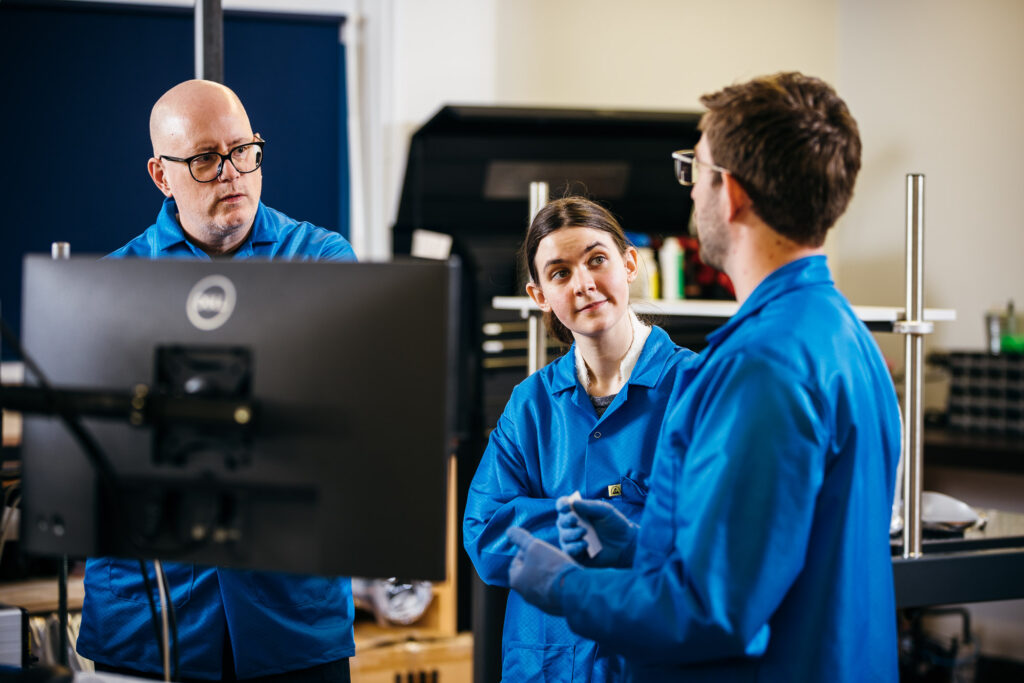
On the software side, she develops code for processing hyperspectral images, currently from the Dragonette constellation, from their raw state into the final imagery product we deliver to customers and creating user-experienced-centred applications. This includes everything from radiometric processing and geolocation to customer ordering portals and mission management software. On the data science side, Ana researches machine learning approaches to various imagery-related initiatives, including, most recently, improving our cloud detection algorithm to enhance the overall performance of our data pipeline.
We asked Ana what excites her about her work: “I am fortunate to work in the earth observation industry, which is exciting in itself!” She continued, “As a team member working on the software that processes our images into their final delivered state, I am especially excited to have a direct impact on building a quality product for our customers that showcases the power of hyperspectral imagery.” Our software team is a small but extremely mighty team, and each team member’s work has a substantial impact on the delivered products: “Seeing such a direct impact of our everyday work is so exciting, and receiving user feedback is motivating to continuously improve our product,” Ana says.
“There is no single "correct" path for everyone in any field of STEM. Continue to explore all of your opportunities in finding your own path to achieving your goals."
We asked Ana, if you could solve any global issue through your work in science, what would it be and why? She says: “Having an impact on solving the global climate crisis was the goal that sparked my interest in the Earth observation field to begin with. In this age of data, hyperspectral satellite imaging plays a crucial role, offering the means to collect information about the ‘unseen’ to humans. Both in terms of size, by spanning large imaging areas at once, and spectrally, by capturing data in wavelengths beyond the visible light spectrum. Put together, I believe this harnesses an incredible power to tackle climate initiatives, including wildfire detection and monitoring, emissions tracking, and more, hence my motivation to work in this industry and contribute towards developing a better future for the Earth.”
We also asked Ana, if you could go back in time, what advice would you give your younger self before entering STEM? Her response: “There is no single “correct” path for everyone in any field of STEM. Continue to explore all of your opportunities in finding your own path to achieving your goals. No predefined standards, expectations, or assumptions should deter you from taking initiative in making these goals come true.” And we’re right there with Ana: forge your own way, take chances, and most importantly, believe in yourself.
Looking Ahead
We must continue addressing systemic barriers to careers in STEM, supporting aspiring women in STEM by providing equitable opportunities and resources, and working towards a future where diversity is a priority in every lab, office, and organization. At Wyvern, we are committed to fostering an environment where women and other diverse individuals in STEM can thrive. It’s all part of creating a better Earth, from space.
– Kristen and Callie, Wyvern Co-Founders
Related resources



Hyperspectral satellite imaging company Wyvern selected for Canada Investment Summit 2026 Pitchbook
Hyperspectral satellite imaging company Wyvern selected for Canada Investment Summit 2026 Pitchbook

Start using
hyperspectral imagery